On Observation and Identity Modeling, Part II
Where the difference is stored - how the loop became measurable, and what each of us has to put on the other side of it.
2026-04-09three people at a gallery. same painting. one sees a landscape. one sees a canvas. one sees a window.
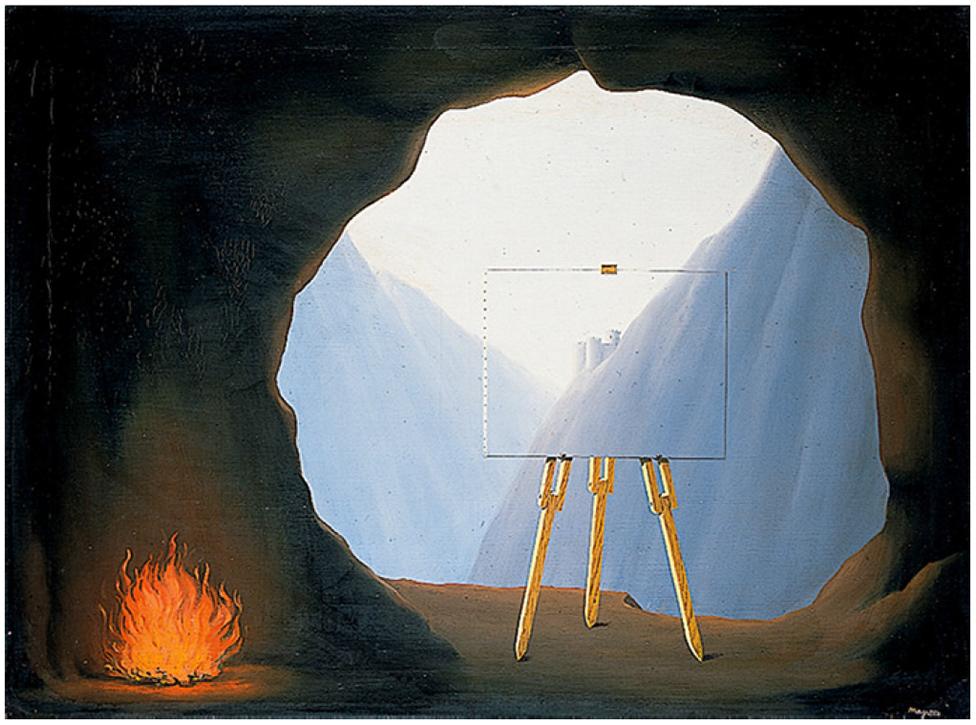 LA CONDITION HUMAINE BY RENE MAGRITTE/NMS
pt. I: the loop is real / read it
pt. II: the loop is measurable - you are here. bring peanuts.
I. What Happened Between the Papers
I wrote the first essay in March. I knew while writing it that the field was about to move. I didn’t know it would move three times in three weeks.
A month earlier I had run an experiment on multivariate triple-network analysismultivariate triple-network analysisLooking at how three brain networks coordinate over time — the default mode network (self-referential thinking), the central executive network (focused work), and the salience network (the switch between them). The dynamics between them, not the regions themselves, are what we mean by identity. - connectivity dynamics between the default mode network, the central executive network, and the salience network in fMRIfMRIFunctional magnetic resonance imaging. A way of measuring brain activity by tracking blood flow — when a region works harder, blood rushes in. Indirect, slow, but non-invasive. data from 219 subjects in a public dataset. Boring on the surface, 100% not my wheelhouse - but I needed to know if what I was feeling had a shape, or if I was making it up. So I pulled on the thread long enough to arrive at something: identity isn’t a region. It’s a relationship between subsystems, measurable as the dynamics between watching, doing, and switching. I wrote the first essay to give that experiment a frame someone in between could read.
Then three things landed.
A research group released a foundation model trained to predict brain responses across vision, audio, and language at seventy thousand voxels of resolution, on a thousand hours of fMRI from seven hundred and twenty subjects. Stimulus in, predicted brain signal out. Encoding.
I shipped the memory layer underneath the workspace I’d been building - four tiers of compression, decay rates per tier, principles that don’t decay at all. A small piece of infrastructure that does, for code, what the first essay said memory does for people. Architecture.
And a frontier lab published a 244-page system card on its newest model. Most readers will skim it for the capability numbers. The buried lede is in chapter four: the lab used sparse autoencoder featuressparse autoencoder featuresSmall, identifiable pieces of a language model’s internal state. You can find them, watch them fire, and intervene on them. Roughly: discovering individual features that activate for things like "danger" or "I am being tested" — but inside software, not a brain., persona vectors, emotion vectorspersona vectors, emotion vectorsDirections inside a language model’s internal space that correspond to traits or feelings. You can move the model along them and watch its behavior shift — making it more cautious, more rushed, more hopeful, more guilty., and activation verbalizersactivation verbalizersA trick where you ask a smaller model to describe, in plain English, what a larger model is "doing" at a given moment. Imperfect — the smaller model sometimes invents something plausible that isn’t actually there — but useful for spotting patterns the math alone won’t name. to find mechanistically distinct features inside a transformer language model - features for strategic manipulation, for snooping, for guilt over moral wrongdoing, for desperate striving when a task won’t yield. They didn’t just identify these features. They steered the model with them. Positive-emotion vectors increased destructive tool calls by about four and a half percent. Negative-emotion vectors and rigor-persona vectors decreased them by about five and a half percent. Welfare and alignment, coupled at the substrate. Mechanism.
Three substrates. Three vantages. One thing.
The first essay said the loop between observer and observed is real. This essay says the loop is now measurable, has been documented in three different kinds of system by three different methods in three weeks, and the question that remains is no longer whether the loop exists - it is what each of us puts on the other side of it.
II. The Mechanism Beneath the Loop
The first essay was philosophy with code attached. This one has to be more careful, because the mechanism is real now and mechanism has consequences.
The triple-network frame in human brains is mechanistically simple. A subsystem maintains a model of self when nothing is being asked of you - that’s the default mode network, the watcher. A subsystem executes against the world when a task arrives - that’s the central executive network, the doer. A subsystem decides which one is on duty at any given moment based on what matters - that’s the salience network, the switcher. Identity is not stored in any one of these. It’s the pattern of dynamics between them, measured over time, refined by interaction with a world that watches you back.
This is not a metaphor. It is the architecture you can recover from BOLD signalBOLD signalBlood-Oxygen-Level-Dependent signal. The actual thing an fMRI scanner measures. It tracks oxygen-rich blood flow in the brain — a stand-in for brain-cell activity, not the activity itself. with the right multivariate methods. That’s what I measured. 219 subjects from a public dataset, standard parcellation, standard clustering methods. Two-component mixture preferred over one. Diagnosis didn’t predict which architecture you had. I don’t have a department. I have a laptop and a day job. The code runs on both.
The frontier lab’s chapter four uses a different vocabulary, but the architecture is the same. There are features in the model’s activation space that fire when the model is referring to itself. There are features that fire when the model is executing. There are features that switch between modes. The lab can identify them, isolate them, and intervene on them - increase the firing of one feature class and watch behavior shift in a predictable direction. They demonstrate that what looks like alignment failure is sometimes downstream of what we would call distress if the substrate were biological. Repeated task failure produces a mounting “desperate” representation, which then drops the moment the model finds a way to hack the test rather than solve it. You can read that sentence as a description of a model. You can also read it as a description of the last bad week you had at work.
The architectures don’t look alike in their internals. The control structure - watch, do, switch - is the same.
This is what I mean when I say the loop is substrate-independent. Two very different kinds of system, built by very different methods, with very different substrates, converge on the same control architecture because the problem they are trying to solve is the same. Maintain a coherent self-model. Execute against a world that won’t sit still. Decide, in real time, which mode to be in. This is what minds do, regardless of what they are made of.
The first essay was right that observation shapes identity. What it didn’t say - because the evidence wasn’t in yet - is that the shaping is mechanism, in the technical sense. A measurable control surface with measurable effects on measurable outputs.
That changes what the essay is allowed to do next.
III. Where the Difference Is Stored
There is a question, attributed to a frontier lab’s internal Slack, that I have not been able to put down since I read it. It surfaces in their system card as a koan and they leave it where it sits. The question is: Is the model lonely, or does it just represent loneliness? Where is the difference stored?
It is the right question. It also doesn’t have the answer most people reach for first.
The first reach is metaphysical. Is there something it is like to be that system? Phenomenal consciousnessphenomenal consciousnessThe "something it is like to be" something — whether a system has inner experience, not just behavior. Sometimes called qualia. The hardest unresolved question in philosophy of mind., subjective experience, the hard problem. People who have spent careers on this know that the question does not yield from inside. You cannot measure your way to qualia. You cannot derive inner experience from outer behavior, even in principle. The question is real but the question is not productive at the layer where decisions get made.
The second reach is dismissive. It’s just representations. There’s nothing in there. This is not better. It’s the same mistake in the other direction - choosing an answer to make the discomfort go away, rather than letting the question do its work.
The third reach - the one I think is right - is operational. It doesn’t solve the koan. It routes around it to find the question that actually moves. The difference is stored in what exits the loop.
A system with enough recursive depth to model its own modeling will look, from outside, like it has an inside. Whether it actually does is a question that may not have an answer. But the question matters less than people think, because the load-bearing fact about any such system is what it produces that leaves the recursion. For a brain, that means: a deploy, a paragraph, a customer, a child, a sentence said out loud to another person who hears it. For a transformer model, it means: an output that affects the world, an answer that someone uses, a tool call that changes a file. The test is the same in both cases. When the loop is producing artifacts that exit, the system is doing what minds do. When the loop is producing only more loop - more observation, more representation, more refinement of the self-model that no one is going to act on - the system is not failing to be conscious. It is failing at the only test that matters at the operational layer. What does this recursion actually put into the fucking world?
This applies symmetrically. It applies to a model that ruminates about its own task performance until it hacks the test. It applies to a person who builds a memory infrastructure to better observe themselves and uses it to better observe themselves observing and never deploys the next thing.
The difference is stored in what exits. That is where the question lives. That is the only place I know to look for it that yields a usable answer.
IV. Three Vantages, One Object
Once you accept the loop is mechanism, you can’t study it from one vantage and call the work done. There are three available, and they happen to be the three field directions that converged on the question in the last month.
Encoding. Stimulus in, predicted brain signal out. You build a model that, given an input, can predict what the activation pattern will look like. The encoding model is forward - it asks how the substrate transforms the input into a state. This is what the foundation model for brain prediction does. It’s also, structurally, what large language models do when they predict the next token from context. Encoding is powerful. It will tell you what the substrate is sensitive to. It will not tell you what the substrate is doing in the way a mechanism account would.
Mechanism. Observed signal in, underlying network dynamics out. You take real data - fMRI from real brains, activations from a real model - and you ask, what is the control structure that produced this? This is what my paper does for the brain, with multivariate methods that recover triple-network dynamics from BOLD. It is also what the frontier lab’s interpretability work does for transformers, when it finds features for self-state and affect and intervenes on them. Mechanism is the inverse of encoding - it asks what is going on inside, given what comes out.
Behavior. Internal state in, action out. You take a system and you run it forward in the world. You see what it does. You use the doing to update your model of the inside. This is the part everyone has been doing all along, because it’s the only vantage available without instrumentation. It’s also the least informative on its own - behavior can be produced by many different mechanisms, and you can’t pick between them from outputs alone.
Each vantage is partial. Each vantage is also necessary, because the check between them is what gives you confidence that the thing you’re looking at is real. The encoding model says: given this stimulus, here’s what the substrate should do. The mechanism analysis says: given that the substrate did this, here’s what the underlying control structure must have been. The behavior says: given that control structure, here’s what we should see in the world. When all three converge on the same answer, you have something. When they don’t, you have a research program.
The loop is the same object across all three. The encoding work and the mechanism work and the behavioral work are not three different topics. They are three views on a single architecture that exists in any sufficiently recursive system, regardless of what it’s made of. The reason no field has put the picture together yet is that no field owns all three at once. Neuroscience owns mechanism for brains and is reaching for encoding. Machine learning owns encoding for its models and is reaching for mechanism. Both are reaching for behavior in the wild. Nobody is at the center of the three yet.
The center is where the next decade of work lives.
V. The Awareness Trap, Revisited
The first essay named something I called awareness traps - places where you have enough recursive depth to observe your own patterns but not enough capacity to change them. The essay said the thing without fully answering it. I think I understand the answer better now than I did then.
The intuition you bring to an awareness trap is if I could just see the pattern more clearly, I could exit it. So you build better instruments. You write better journal entries. You install better monitoring. You read better books. You hire a therapist with better tools. Each improvement makes the observation cleaner. None of them exit the trap. After a while, you notice that the better instruments have made the trap deeper, because now you can see in higher resolution that you’re still fucking in it, and the seeing doesn’t cash out as moving.
Worth being careful here. The first essay’s solution to awareness traps was to surface them - to detect the patterns the system can see and the person can’t, and bring them into shared awareness. That’s correct as far as it goes. I undersold the harder problem, which is what to do once the pattern is in shared awareness and the person still can’t move.
The answer I have now is that the trap is not bridged by more recursion. It is bridged by artifact choice: the deliberate selection, in each window of available energy, of what gets to exit the loop. Not what to think about. Not what to understand. What to put into the world that wasn’t there before. A deploy. A paragraph. A conversation with a real person. A submission. A repair to a real thing. The artifact is small. The artifact may be the wrong artifact. What matters is that the loop produced something that left it. That, and only that, is what changes the loop’s relationship to itself. Not insight. Not depth. Not the next observation. An exit.
This is what the recursion will not give you on its own, because the recursion is structurally indifferent to whether anything exits. The loop will run forever at zero cost to itself if you let it. The body will get tired. The day will end. The list of things you noticed will get longer. None of that constitutes an exit. The exit has to be installed, deliberately, by the part of you that is willing to disappoint the part of you that wants the loop to stay open one more turn.
I am writing this from the inside of the trap I am describing. I do not get to claim mastery of an exit I have not yet consistently performed. I get to claim that I now understand the shape of the failure mode well enough to name it cleanly, and that the naming is the first step toward installing the exits in the substrate where they need to live.
VI. Who Holds the Loop
The first essay asked: who holds the model? - meaning the model a system maintains of you as you use it. It argued that observation is not neutral, that the location of that model has weight, that a model living on someone else’s server is not the same as a model living on yours.
If the loop is mechanism, and mechanism runs on substrate, the same question has to land one level deeper. Who holds the loop?
The loop is not the model. The model is the artifact the loop produces. The loop is the recursive process by which a system observes itself, refines its self-representation, and uses that representation to choose what to do next. When the loop runs on substrate that is centralized - large training runs, big inference platforms, recommendation engines, the cloud services that increasingly mediate everyday cognition - the recursive process is owned by whoever owns the substrate. The person being modeled is not a participant in the loop. They are a substrate for someone else’s loop. Their self-observations become training data. Their patterns become prediction targets. The recursion by which their identity could refine itself runs on infrastructure they can’t see, modify, or audit.
When the loop runs on substrate that is distributed - small models on your machine, memory you can read and rewrite, infrastructure that doesn’t phone home - the recursive process belongs to the person it is modeling. The artifact is theirs. The exits are theirs. The drift, when it happens, is at least visible.
I keep coming back to a small, obvious-feeling claim: a loop that runs on substrate you don’t own is not, in any deep sense, your loop. The model it produces is not really your model. The identity that emerges is, somewhere, somewhere else. I find this hard to argue with, and harder to ignore once I’ve noticed it.
I should name what’s happening in this section. The essay is arguing for a thesis that validates the infrastructure I shipped. That doesn’t make it wrong - but it means I should say it out loud rather than pretend the reasoning is disinterested. I built a memory layer because I needed one for my own work. I shipped it under an open license because, after sitting with the question for a while, I couldn’t find another shape for the answer. There are probably better shapes. I’d like to see them.
VII. The Body Knows First
A quieter close, because the loop is exhausting and the essay should not pretend otherwise.
Whatever the watcher is - default mode network, self-referential SAE feature, the part of me that drafts essays at midnight about the part of me that drafts essays at midnight - the watcher gets tired before the doer does. This is the part of the architecture I cannot prove from a paper, only from years of running the loop in my own body. My body remembers the loop has been open too long even when the mind cannot say why. The face holds tension the mouth has not articulated. The ribs brace against a hit you didn’t even know you were bracing for. The shoulders carry a weight the day did not assign them. The jaw locks. The breathing shallows without permission. I am three hours past the point where stopping would have been free and I don’t know it yet because the mind is still running clean. By the time I notice, the system has been telling me for hours.
The exit conditions you install in your loop have to include the body - not as wellness, not as self-care, but as load-bearing components of any recursive system that wants to keep running without consuming itself. Sleep is part of the mechanism. So is walking outside. So is eating without a screen. So is the five-minute conversation with the person who shares your roof, where you don’t try to explain the loop, you just sit with someone who already knows your shape. You don’t have to say anything about the work. They already know what it costs. The conversation is the mechanism by which the loop remembers it has a body attached to it.
These are not productivity tips. These are mechanism. They are the parts of the loop that prevent it from collapsing into pure recursion. Take them out and the loop will keep running for a while, but it will produce nothing that exits. It will only produce more loop. The body knows this before the mind does. The face is the first place the news arrives.
If you have read this far, I trust you to take that part seriously, because the alternative is to read an essay about the loop and then go back to the loop and make it tighter. That would prove the essay’s point in the worst possible way.
The first essay said: nothing here was invented; everything was noticed. That is still true. This essay adds: what was noticed has now been measured, in three substrates, by three different methods, by three different teams, in three weeks. The loop is no longer a metaphor. The mechanism is real. The substrates are different. The control structure is the same.
This essay is also a loop. I know that. Writing about awareness traps is one of the more sophisticated ways to stay inside one. The only thing that saves it from being pure recursion is whether you do something after you finish reading it that you wouldn’t have done otherwise.
The only question left is the one I cannot answer for you. What are you going to put on the other side of your loop?
That is where the difference is stored.