Guardian
A desktop app for local inference that became ForgeFrame. Reframe detection, pattern tracking, encrypted notes - the engine got extracted, the shell didn't survive it.
Goals
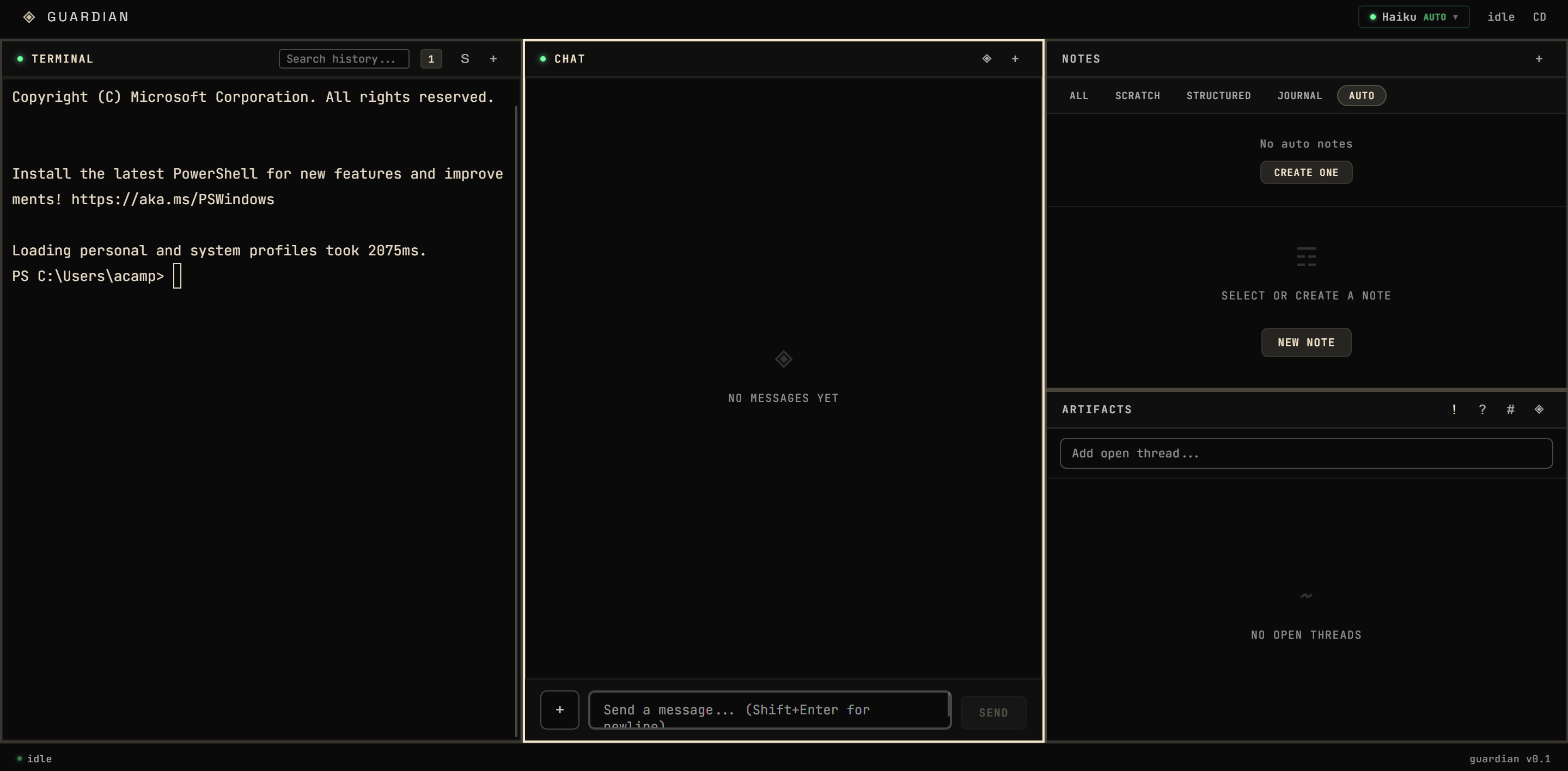
Guardian was ForgeFrame before ForgeFrame was a separate thing - the same engine (memory, decay, principle-tier tagging) wrapped in a desktop UI for end users instead of developers. It tracked how model responses shift over time and kept sensitive data local. When the memory layer got extracted into standalone infrastructure, the shell had nothing left to justify, and the engine lives in ForgeFrame now. This page is the research record; the hall of shame has the post-mortem.
Process
Started as an Electron shell with a chat window and a local Ollama connection. Built outward from there.
Routing. Provider-agnostic engine across Anthropic, OpenAI, and Ollama. Auto-selects by intent complexity and cost. Runs air-gapped on local models or through cloud APIs.
Reframe detection. Classifies when model responses subtly reshape user statements across 7 types. Triggers prompt correction when user-rated inaccuracy exceeds 40%.
Unresolved-pattern detection. Separate from reframe detection — identifies topics that recur across sessions without resolution. Schema, accessors, and pipeline integration wired into the post-session flow. Detects multi-session conversation patterns where the same topic returns without progress toward a decision or action.
Memory. 4-level compression pipeline (raw -> summary -> pattern -> principle). Strength decays over time, reinforces on retrieval.
Sovereign encryption. Notes support sensitivity levels and context gating. Encrypted at rest with IPC-based unlock/lock cycle. Private notes stay private — they don’t flow into cloud context even when cloud providers are active.
ForgeFrame fusion. JSON-RPC stdio client bridges Guardian to ForgeFrame’s MCP memory server. Sessions sync bidirectionally. Data migration pipeline handles the transition from Guardian’s internal SQLite to ForgeFrame’s shared memory layer.
Post-session pipeline. Fires on conversation end. Extracts decisions, tasks, and code artifacts. Generates typed notes. Indexes into FTS5 for search. Links entities into a knowledge graph. Runs unresolved-pattern detection.
Limitations
- Reframe detection uses heuristic classification, not a trained model. False positive rate unmeasured.
- Memory compression thresholds are hand-tuned, not empirically optimized.
- No formal user study on reframe detection or unresolved-pattern accuracy.
- Sovereign encryption is functional but not audited by a third party.
Learnings
The hardest problems were state synchronization and process lifecycle management, not the models themselves.
Reframe detection surfaced a deeper problem: models subtly reshape your language over time. Detecting that requires understanding the user’s baseline, which requires memory, which requires local persistence. That dependency chain is why ForgeFrame exists.
Unresolved-pattern detection surfaced something else: cross-session recurrence isn’t visible within any single conversation - it’s visible only across them. You need memory that spans sessions to see which topics return without progress.
Guardian is where the essay on observation and identity modeling came from. Everything I describe there — the loop, the reframe types, the four quadrants of who-sees-what — I found by building this and watching what happened.